Pai Gow Poker originated in the mid-1980s. The game was modeled on, named after, and is often confused with the Chinese Tiles game also named “Pai Gow,” which dates back to the Song Dynasty, 960 to 1279.
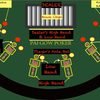
The game is played with a standard 52-card deck, plus a single joker. It is played on a table set for six players, plus the dealer. Each player attempts to defeat the banker (who may be the casino dealer, one of the other players at the table, or a player acting in tandem with the dealer as co-bankers).
Why Pai Gow Poker?
The Strategy is not hard to learn, and the house edge is roughly 2.84%. Because the game is slow (Over 60% of the hands played will end in a push), the hourly loss is often lower than Blackjack or Slots.
Another thing that slows down the play is that all six player spots are dealt, whether there are six players or fewer.
Unfortunately, due to the low house edge, rewards points are often slower to accrue.
Getting Started
HELPFUL NOTE #1: Always place cash in front of you when entering the game. Dealers cannot take money directly from players’ hands to their hand.
Usually, each hand is shuffled by an automated Shuffle Master. Players wait for the Shuffle Master green button to go on, signaling a good shuffle before picking up their cards. Four cards are left over, which no one sees. The dealer will signal when it’s ok to pick up your cards.
Setting Your Hand
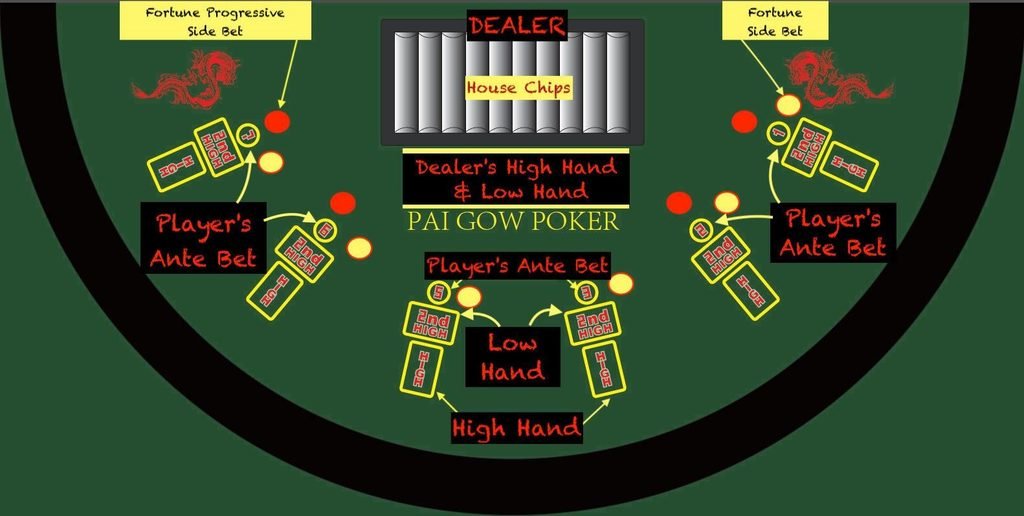
Each player is dealt a seven-card hand, which is split into two hands – one with five cards and the other with two. The five-card hand (High Hand) must have a greater value than the two-card hand (Low Hand).
A player wins if both hands beat both of the banker’s hands. Players lose if the dealer/banker’s hands beat both of the players. If one hand wins but the other loses, a push occurs. This means that your bet is returned. If a player ties with the banker, the banker wins. On a push, any side bet is still in play.
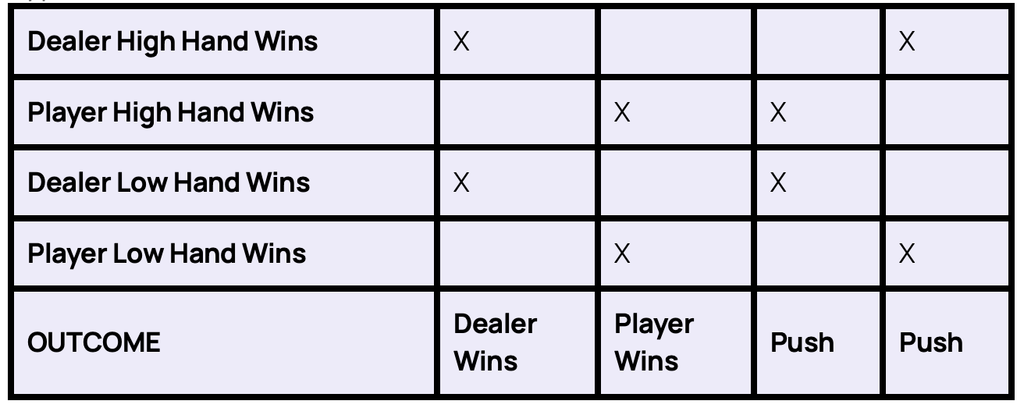
Any hand matching the dealer is a loss to the player.
HELPFUL NOTE #2: Often, dealers will be able to help players arrange their hands according to the “HOUSE WAY,” which are the casino’s rules that apply for the dealer to set his hands.
Once players have set their hands, they place them in the correct spot on the table, face down. Play continues when all players have done so.
HELPFUL NOTE #3: Be careful setting up your hands. Make sure the high and low hands are indeed the high and low hands. If you set your cards incorrectly, you’ll automatically lose, at least at some casinos. At others, they may give you the opportunity to correct your mistakes. Better safe than sorry though.
The Joker in Pai Gow
The Joker in Pai Gow is not the usual whatever-card-you-want wild card. Instead, the Joker in Pai Gow is called a “bug.” It acts as an ace, or it can be used to fill out a straight or a flush. This also means that you can have five aces, which is the best possible five-card hand in Pai Gow.
Basic Strategy Tips
- Dealt Two Pairs
- Don’t always split pairs. In some cases, you’re better off keeping both pairs in the High Hand. At worst, you’ll push the hand.
- When splitting 2 pairs, be sure to place your strongest pair in the high hand (weakest pair in front).
- Dealt 3 of a Kind
- With 3 of a kind, only split them up when you are holding aces. Keep a pair in the High Hand and one ace in the Low Hand.
- Dealt 3 Pair
- split them up to have 2 pair in the High Hand and the strongest pair in the Low Hand.
- Dealt 4 of a Kind
- Unless you have a very strong High Hand, split them up, putting a pair in each hand. The exception to this rule is if you’re holding quad 2s through 6s. Always keep these hands intact.
- Dealt Full House
- Split full houses. This is counterintuitive; I know. But chances are high that if you keep the hand intact (in back) that you’ll push (at best). When you split the hand up, you have a higher chance of winning both hands
- Taking Over as Banker (Advanced)
- Under certain circumstances, some casinos allow players to be the banker. I only suggest this for more advanced players having the table to themselves. Mohegan Sun in CT allows players to be the banker, but not in consecutive hands.
Final Consideration – Side Bets
Many advanced players suggest not playing side bets. Playing side bets is the oldest way the casino adds a higher house edge to the game. However, side bets also add more excitement and are independent of the main Pai Gow hand. So you can lose the main game and still cash a side bet, or win the main game and miss all side bets.
There are usually three possible side bets at most Traditional Pai Gow tables.
- Fortune Bonus: This is the main side bet. The paytable varies in casinos, so be aware. Most versions start paying at three of a kind or better, with bigger jumps for rarer hands.
- Envy Bonus: More players mean more chances. Basically, if someone hits a qualifying bonus hand, the Envy bonus is triggered, and anyone betting the Envy bonus also receives a flat amount.
- Progressives: Much like slot machines, a progressive wager’s expected value improves as the meter grows.
Remember, playing side bets adds volatility, a need for a larger bankroll, and increases the house edge.
SUMMARY
Traditional Pai Gow Poker is a fairly easy table game. Knowing the rules and strategy will increase your chances of winning a slow but fun game. I would suggest staying away from side bets until you feel comfortable with the game.
Recently, a newer version, Face-Up Pai Gow Poker, has appeared on casino floors. For a comparison of the two variations, read Pai Gow Poker: Traditional Versus Face Up from our very own John Mehaffey.