This page contains affiliate links on which we may earn a commission. Learn more about our editorial policy.
Double Double Bonus seems to be among the favorite video poker games across the country these days. It offers the excitement of great payouts, especially quads (four-of-a-kind) Aces and 2-4s with a kicker. But the strategy is different from the standard Jacks or Better game. So, let’s look at Common Double Double Bonus Mistakes.
Introducing Double Double Bonus
The name “Double Double Bonus” (DDB) video poker was the great beginning of variations of good old Jacks or Better – first Bonus poker, then Double Bonus, then DDB. Each variation increased quad payouts but lowered the hands that came up more often, such as Two Pair through Full House.
DDB Pay Tables
Casinos have tweaked DDB pay tables often, creating a wide variety of paytables varying Return to Player Probability
Just a Reminder – the first number represents the payout for a Full House, and the second number represents the Flush payout. FOR EXAMPLE: In 10/6 DDB, a Full House would pay 10 for 1 and a Flush would pay 6 for 1. Check out our article for more information on reading video poker pay tables.
The best Expected Value (or EV) for 10/6 DDB is 100.07% is with perfect strategy. But before you get too excited, know that the 10/6 pay schedule for DDB is rare everywhere – more uncommon as a year-round Dairy Queen in New England.
The second best paytable is 9/6 DDB (a 98.98% EV) is available in many casinos at the higher $5 and above denominations – sometimes even at $1. Unfortunately, most quarter players are stuck with the availability of 9/5 or even 8/5 DDB games with 97.87 % and 96.79% payback, respectively.
For those playing multi-hand games, expect 8/5, 7/5, or even 6/5 at some casinos that see video poker players as a threat (yes, I’m talking to you, Bally’s Twin River Casino in Lincoln and Bally’s Tiverton in Rhode Island!).
Common Double Double Bonus Mistakes
Here are some Common Double Double Bonus Mistakes. We will be using the common 9/5 paytable that pays approximately 97%.
These mistakes are common because many players use a strategy similar to Jacks or Better. The JOB strategy doesn’t give the player the best return. The importance of quads and kickers with Aces and 2-4s is crucial. The payout in DDB always diminishes two-pair to even money, which changes the strategy from the JOB greatly.
Example #1
How would you play the hand below? #1
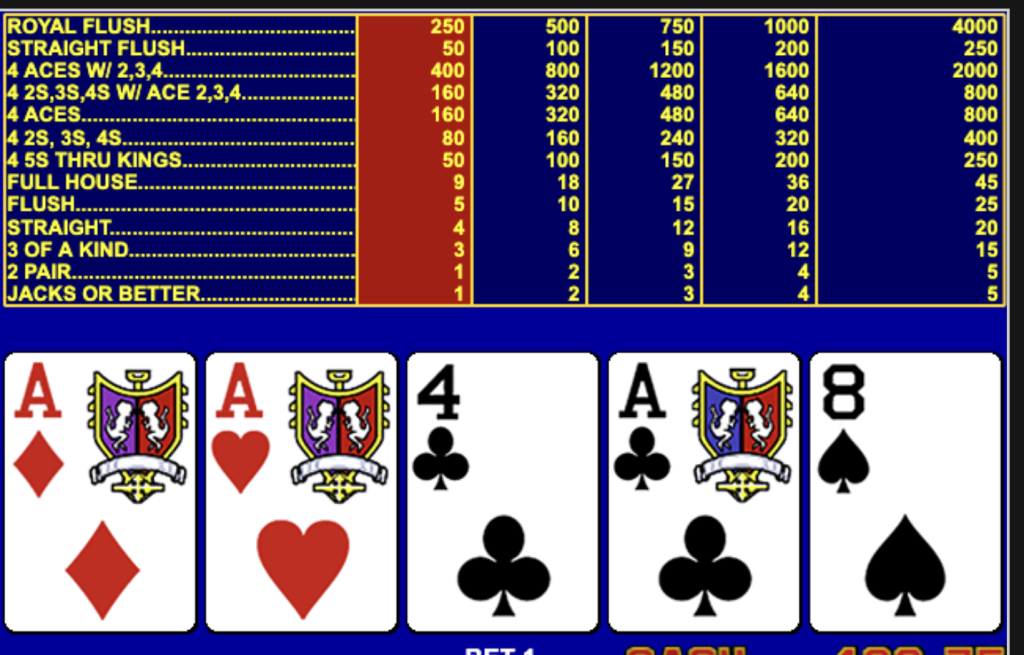
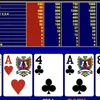
Many players would hold the three Aces and the “4” kicker. They hope to draw the fourth Ace for a 2000-coin payoff. But that’s a common blunder. The hold with the most value is holding only the three Aces for a 3% higher EV.
Example #2
Ok, let’s try another. #2
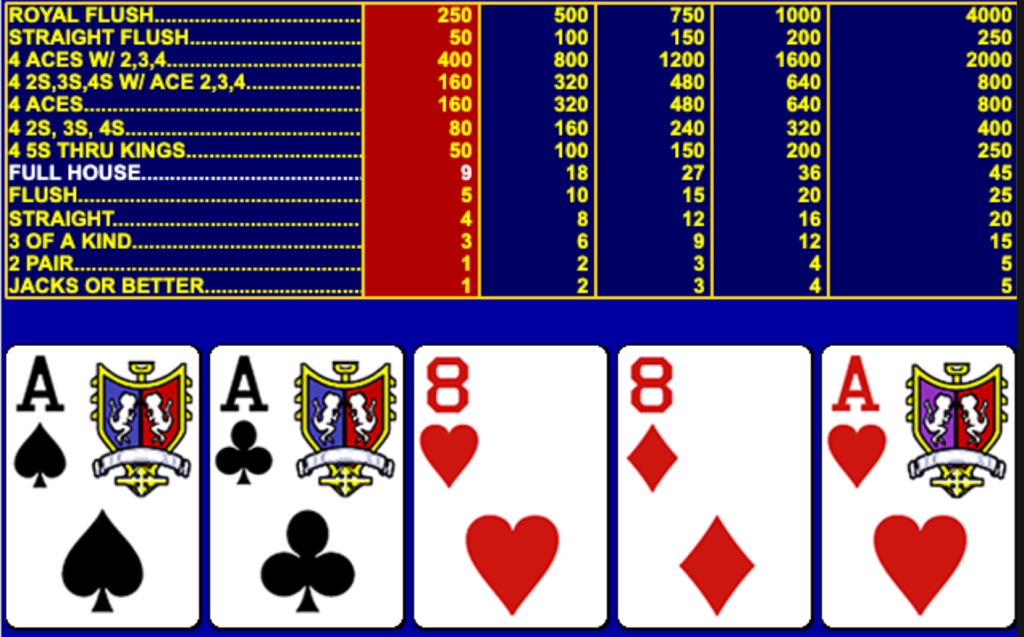
Another instance of Common Double Double Bonus Mistakes concerns “made hands.” Here is an example of a “made hand” – a full house dealt. Typically, you would keep the “made hand.” But, in DDB, that would be another blunder. In DDB, always break up a full house if your three-of-a-kind is A-A-A. This is due to the high value of Aces in DDB.
Examples #3, #4, & #5
Here are three more. What would you hold? #3
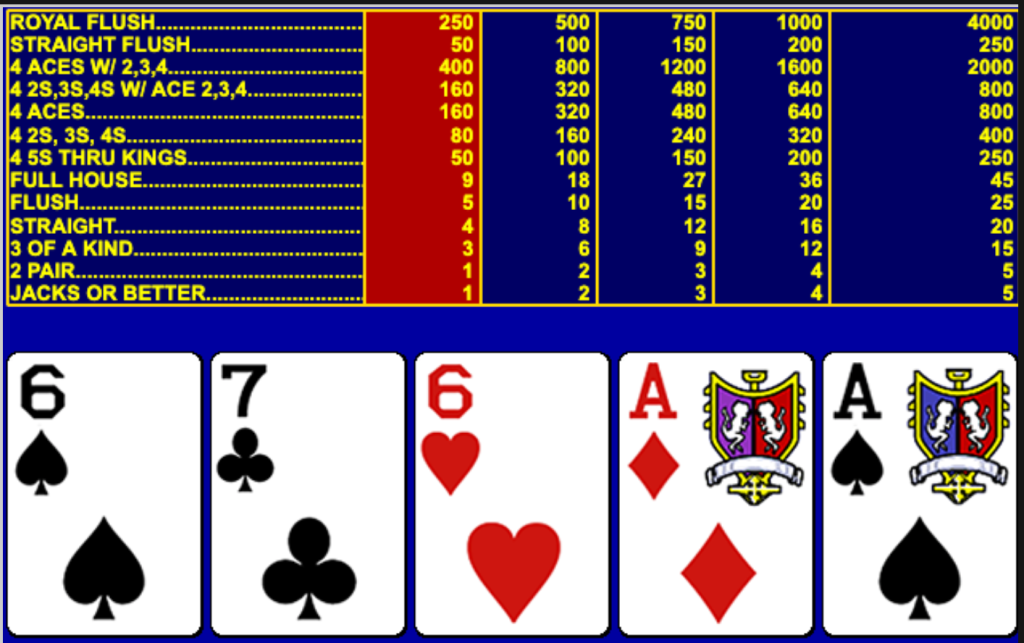
#4
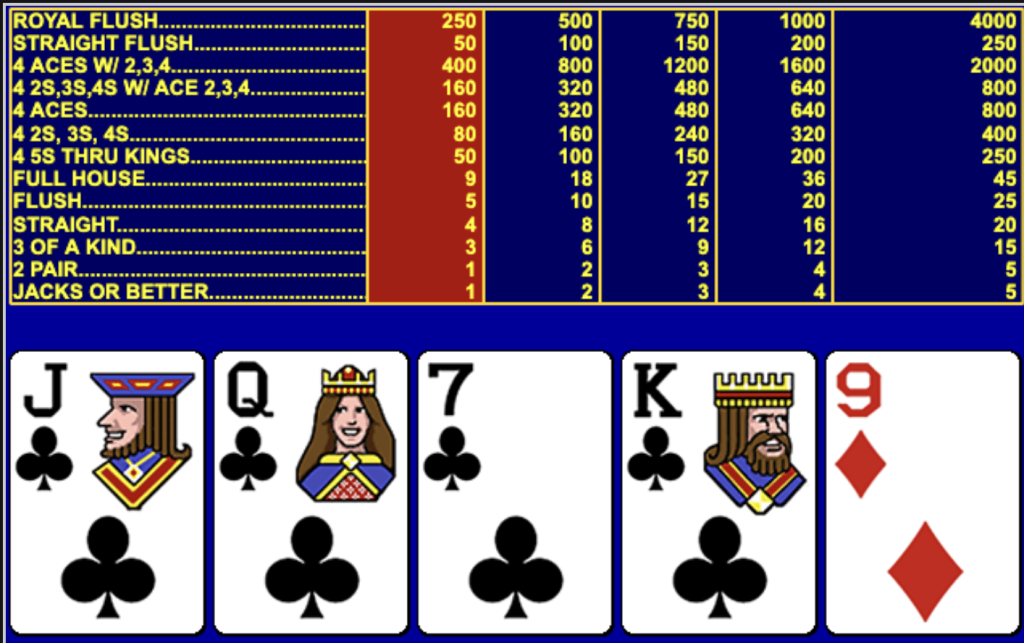
#5
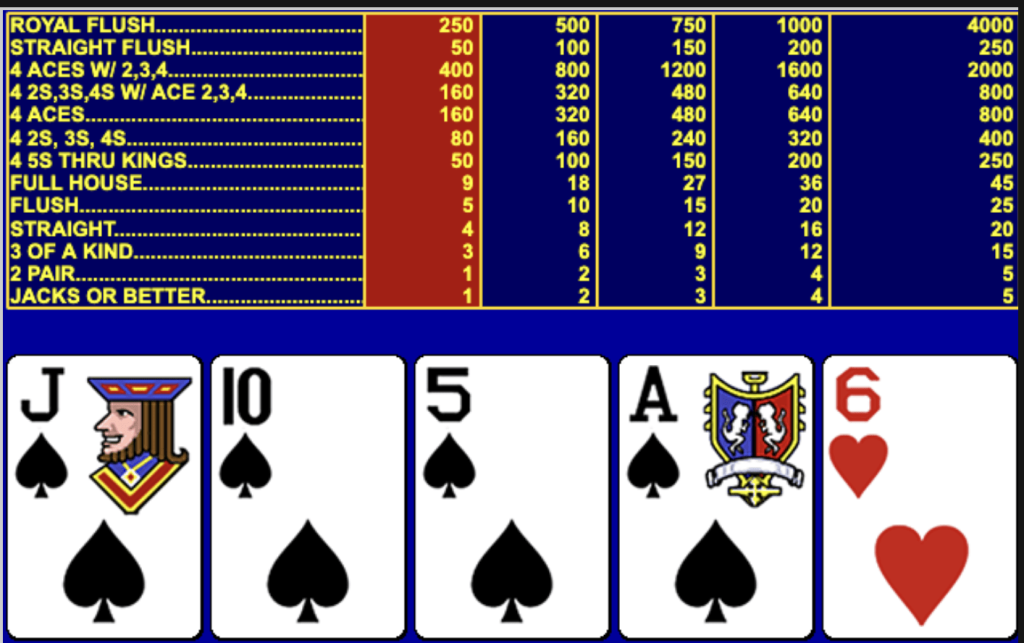
Hand #3 – This hand is blundered by most players. This is especially true if they are accustomed to playing Jacks or Better (JOB). In JOB, the correct hold is the two pairs. But, in DDB, the correct hold is the pair of Aces because of the higher value of the Ace.
Hand #4 & #5 – Most players play these wrong. Here’s the rule. With one exception, you should hold a three-card royal flush over a four-card flush. You should hold the four-card flush if your three-card royal has an Ace and a ten. This is also true with a J, Q, or K.
So, in Hand #4, you hold three cards to the Royal Flush. Then, with Hand #5, hold the four cards to the flush.
What would we keep in this example of DDB in Ultimate X?
Ultimate X gives multipliers to the next deal of that winning hand. The multiplier amount depends on the winning hand. A winning pair equals 2X. Two pair equals 3X. Three of a kind equals 4X, etc. The multipliers differ with base games – JOB, DDB, Deuces Wild, etc.
You Need a Bigger Bankroll for DDB
Double Double Bonus has high volatility, which means it has higher swings in the wins and losses than lower volatility video poker games. Most players lose their “bankroll” rather quickly when their bankroll is too small for a particular game. Most players play DDB under-bankrolled. This is the most common Double Double Bonus mistake.
Example
Suppose you were to compare the bankrolls needed for both 9/6 Double Double Bonus and 9/6 JOB). Both games have roughly a 99 percent expected return (ER). However, the variance (volatility) for 9/6 DDB is much larger. The variance for 9/5 DDB is even larger than that.
Let’s assume you have a $200 bankroll and want to play for two hours or approximately 1,000 hands at $1.25 a hand.
The probability of losing all of your bankroll for each game is:
- 9/6 Jacks or Better Poker – you will lose your $200 stake only 3% of the time. This happens in roughly 1 out of every 40 sessions.
- 9/6 Double Double Bonus Poker – you will lose your $200 stake almost 30% of the time. This happens in roughly 11 out of every 40 sessions.
The point is that video poker games with high volatility, like Double Double Bonus, need a bigger bankroll.
A Bonus Tip – DDB in Ultimate X
Many players, me included, love to play DDB in the multi-line Ultimate X. With most multi-line video poker games, players should not deviate from using the base game’s perfect strategy. But Ultimate X is a different beast. It’s a volatile game, and if you play DDB as the base game, well, volatile + VOLATILE = VOLATILE!!! But if you like the excitement of big payouts with multipliers in play, go for it! However, it does require changes in your single-line optimal strategy.
Takeaway
Double Double Bonus Video Poker is not an easy game to master. My suggestion is to practice with a strategy card beside you. A subscription to videopoker.com gives you advanced practice and stats on your play.