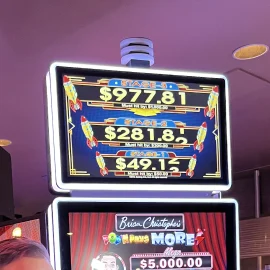
We’ve talked about the Random Number Generator (RNG) as it pertains to slots here quite a bit, but that doesn’t mean there aren’t still questions. He’s a recent example:
If every slot is controlled by a Random Number Generator, why aren’t there more wins than losses? There has to be some programming that goes into the algorithm, thus making it not really randomly generated.
Karolyn L.
Well, Karolyn, it’s really about shifting focus from the RNG to the stack of outcomes. The RNG itself is what’s dubbed “pseudo-random,” as it’s created by a human – but it’s sufficiently random to ensure the outcomes are equally possible to come out.
What is controlled, and guarantees the casino wins over time, is that stack of outcomes. The stack of outcomes determines what percentage of spins will be winners and losers over time, and how much can be won over time.
The simple example we like to give is imagine there’s 1 million possible outcomes on a slot machine. Let’s say you bet $1 for each outcome, so $1 million in total is wagered, and the amount won on all of those possible outcomes it $900,000. That means that the slot is designed to pay back 90 percent, over time.
Since each outcome is possible to come out at any time, statistically, over time, each outcome will come out about as often. But in real life, maybe outcome 23 comes out 4 times and outcome 12 comes out 3 times, and so on. But the more spins that are completed, the more likely it’ll approach its intended target.
So, accordingly, the percentage of winning spins is determined by those outcomes, as is the payback, and that’s how it’s designed to be random, but still make money for the casinos. It’s random, but only within a pre-selected range of possibilities.
Have a question? Submit yours here!