

There was a time when slot bets were generally pretty predictable. The number of lines equalled the number of credits you needed to bet.
This isn’t the case anymore, and over time some more unusual bet options have popped up, and a player wonders what that’s all about:
Why do slot machines have bets like 1.76 or 2.88? Why not have even dollar amounts?
Melissa M.
Both of the examples you’ve cited are based on the concept of 8s, which tends to link back to Asian cultures and their belief of 8 as a lucky number because of its similar sound to the word for wealth. Because of that, 8 tends to be a symbol of success and prosperity. This is why the number 8 is prominent in many games with an Asian theme or motif.
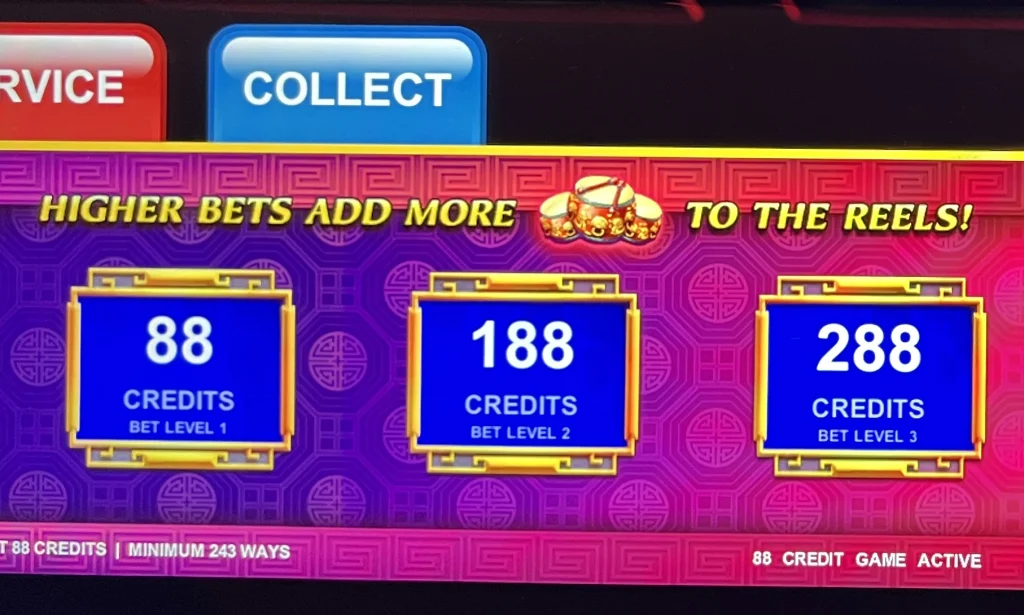
A lot of the games with bets like $1.76 have that as their second bet level… with their first bet level being 88 cents. Examples of this are Dancing Drums and Fu Dai Lian Lian.
The $2.88 is a newer variation, seen as a step on games that also start with an 88 cent bet, but step up to $1.88 and $2.88, which include Dancing Drums Explosion and Monopoly Lunar New Year.
The change from clean multiples of your bet ($1.76) to non-multiple steps ($1.88) is slot manufacturers grabbing a few extra pennies per spin to boost the bonus quality.
You’ll notice on games with these unusual steps there’s often language on the bet panel that speaks to increased chance of bonuses as you increase your bet. That extra little bit of money is what’s paying for that, essentially making it a built-in version of a more/better bonuses bet.
So ultimately, it’s leaning into good luck superstitions of certain cultures, and manufacturers leaning into that concept in their games.
Another helpful side effect of having more bet options is the games will feel different because how much money is put in has an effect on what a game can pay out. Having 88 cents a spin wagered vs. 50 cents or even 75 cents will give game makers more money to work with in terms of the payouts, and so that can reflect in how a game plays and feels.
Have a question? Submit yours here!











What happens if the slot machine doesn’t pay back the state minimum payback amount? So if state min is 83% and the machine only pays back 72%. Does someone get in trouble or fined??
Well, for starters, that’s very unlikely to even be a possibility, because slots are generally designed with a floor of 85 percent. But in the unlikely event a casino had this setting option in a machine and somehow did it by accident, a fine would be the minimum. If a casino was doing it intentionally and systematically that would generally cost them their gaming license altogher. But we wouldn’t worry about this – we’ve spoken with multiple gaming commissions on the topic (because people keep claiming their local casino ignores the law and just pays the fine, although they can never offer proof of this) and they couldn’t cite a single example of a machine being found to pay below the minimum allowed by law.