

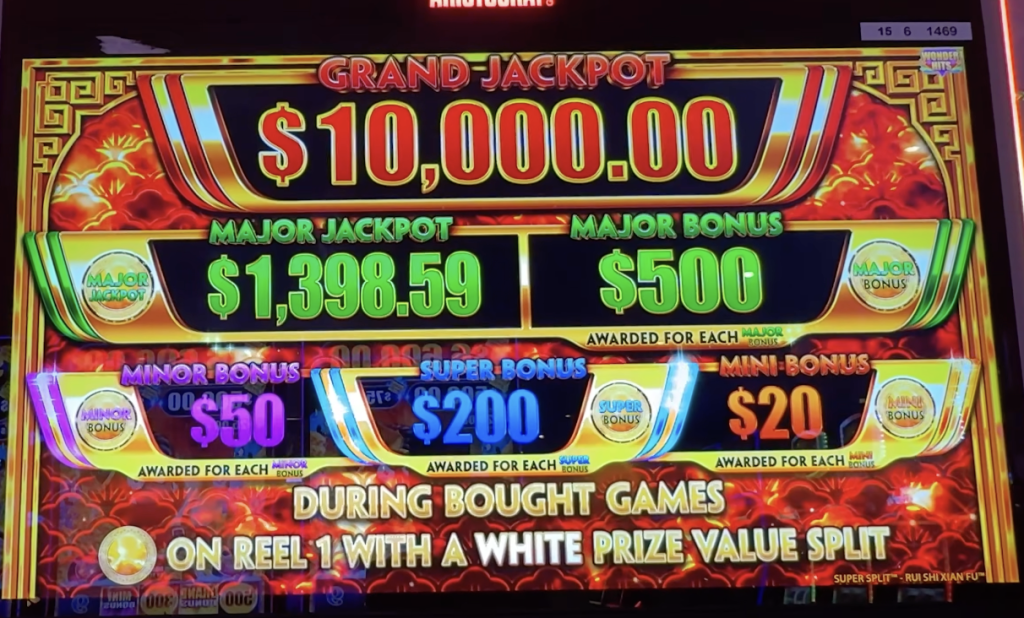
Spend time in cruise ship casinos and you’ll begin to notice something pretty consistent – while slots with multiple progressives have Major progressives that grow, Grand jackpots do not. Is there a purpose to the decision?
Casinos on cruise ships have progressive Majors but many don’t have progressive Grands? Why not?
Joe
There’s likely multiple reasons for the decision, all of which make some sense when you think about the structure of a cruise ship casino.
It Caps Overall Payouts
Cruise ships don’t have unlimited cash given the limited space on the casino, and it’s bad form for a casino to have too many jackpots for the amount of cash it can float for those jackpots.
One aspect that can make it risky is the element of a growing progressive that can build to much larger numbers before finally being hit. With limited cash on hand, enough bigger progressives could be a logistical challenge for cruise ships, so it’s easier to cap the prizes as a liability limiting step.
It Lowers Paybacks
Cruise ships aren’t the only places you’ll see capped progressives – bigger markets like Las Vegas and Atlantic City feature casinos (largely owned by the larger corporations) that cap some progressives as well. The reason is simple – that 1-2 percent of wagers that would be feeding the progressives go directly to the casino’s bottom line instead since they don’t have to be awarded.
While a percentage of that money pays for the seed that starts the progressives, since there’s still a starting prize to award, the incremented amounts are effectively additional house edge money. With cruise ships understandably being at the lower end of the payback range for slots, this is a step that helps with that.
Game Developers Don’t Like It
Over the years we’ve spoken with a number of people in the industry, and the sentiment we get is they don’t think these decisions are a good idea, in part because these features serve a purpose. If you know a Grand starts at $10,000 and you see it as a bigger number, it might entice you to play it, which is a casino’s goal, after all.
We’ve seen some wild examples of big top progressives that have been building for awhile, such as $50+k Mega jackpots on the original Ultimate Fire Link series. So to have it be permanently fixed to $10,000 could be one less thing to draw a player in.
That said, cruise ships have a captive audience, so that may be less of a concern, and the other needs may outweigh the marketing benefit.
Have a question? Submit yours here!













Psychologically, a cruise ship probably realizes they only have a gambler for between 4-7 days, so capping the grand let’s the gambler feel like their wager has a good shot at landing it before the ship sails off again. On the land based casino, drawing on the local market, a growing grand can lure the same people back weekly or daily even, trying to hit it. And without the cost of a cruise a local can be expected to make more frequent visits to try for the growing grand.
The captive audience that a cruise ship provides likely provides less of a need to entice a player to sit down and play a machine. Cruise ships have limited machine selections and with a long window of time on a ship you’ll probably play much of what’s on there over the course of a full sailing regardless of grand jackpot size. But the game makers still put those progressives on there because they work to get player attention, and that is a lost feature when a cruise ship chooses to cap them.