

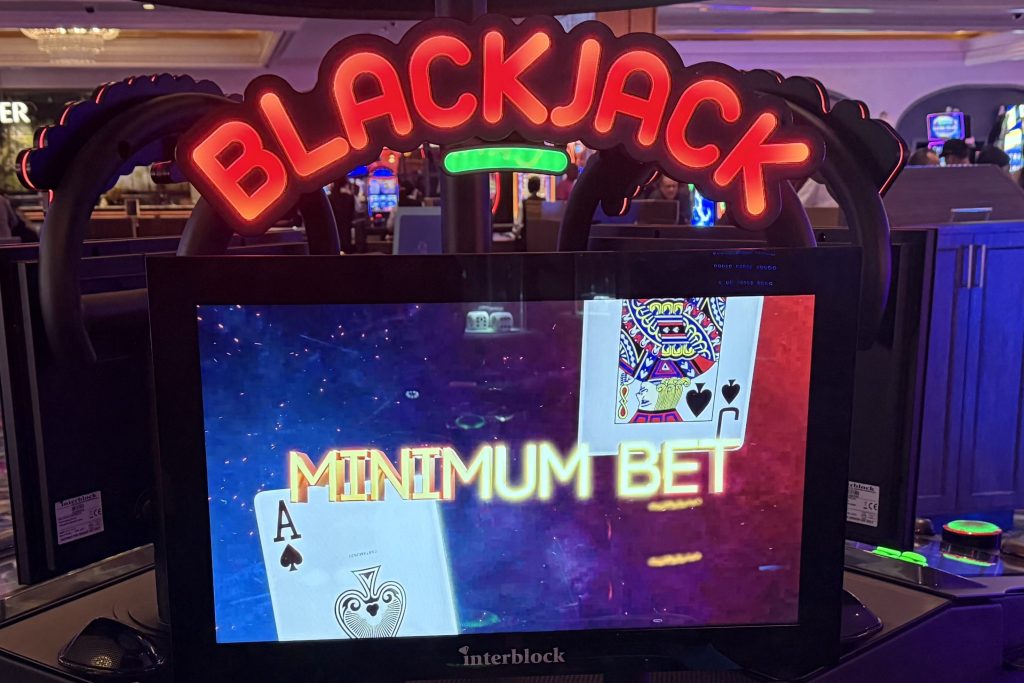
As I’ve shared here on the site recently, Blackjack has taken focus for me as slots have been a difficult roller coaster to enjoy at times (a recent casino budget wipeout within a half hour round of slot play – way shorter than that budget should have survived – was another reminder of this).
The $3 table my local casino has is often an easy way to have fun for a few hours and not break the bank, but having a minimum that low tends to attract a lot of people who don’t know what they’re doing. I watch people splitting 10s, staying at 14 against a dealer 20, and other scenarios that, over time, will cost more than following basic strategy.
Often when you aren’t sure of a scenario, you can ask the dealer, who will potentially reference ‘the book’ and what to do. The book is effectively what mathematicians have worked up, based on the various odds of things happening based on how many unique cards there are, and the best expected return option is the one a player should proceed with.
That means, for instance, not splitting 10s – a hand of 20 is generally a favorable one. If you get a pair of aces, it’s best to split, because you have a decent chance of making 21 on each hand. And so on.
So this takes me to a recent visit at the table. There were a number of people who were a bit unsteady on their feet about scenarios. In the first base position (the first seat at the table) was a player who was playing consistently but doing weird things like splitting 10s. And then there was myself, who knows enough about basic strategy to be a pretty steady player on what to do in various scenarios.
One of the newer players got a pair of 8s against a 10. 8s are generally a must split hand because you’re breaking a hand of 16 into two hands you’re hoping will outperform the original hand.
And certainly, having a decent likelihood of making hands of 18 when the dealer likely has 20 sounds like a potentially risky one. But the dealer will have a 10 under there only about a third of the time, given the distribution of cards, and with the Blackjack check there’s already a confirmation of no ace, eliminating the riskiest of all.
Conversely, you might get a 2 or 3, which could lead to a 20 or 21, so your chances of improving from a hand of 16 on either side is even better than just drawing 10s.
But what aggravated me is that there was a player giving bad advice. I mentioned ‘The Book’ at one point and the player contradicting my suggestion said the book was written by casinos to make them more money. I replied the books was written by mathematicians to help players lose less money – the casino already has the advantage so they don’t need to do anything.
The dealer was understandably staying out of it because they weren’t asked. And it’s a reminder as players that if you’re not sure about a scenario, there’s a few things you can do.
One is if the casino allows it to get a strategy card that can help decipher the various hands possible and what you can do. Another is to learn the basic strategy over time (with the strategy card’s help). This is effectively ‘The Book’ as a cheat sheet. But some casinos are more comfortable letting players do this than others.
Practicing at a table like the $3 one we have is great because you get some real world experience at an affordable price (you can do the same on Game King casino machines that feature Blackjack as an option, as often you can play it at low stakes).
And ultimately, many players are open to helping newer players learn. But as I saw, players can be misled by others who don’t know how to play, and that will simply cost them money over time.
So be sure if you ask for advice at the table to double check and make sure it was good advice (even after your session) so you’re not destined to repeat mistakes you learned from less than savvy players.
Your gambling budget will thank you, as playing correct strategy, over time, will cost you less money than making plays that go against the best option available.













