

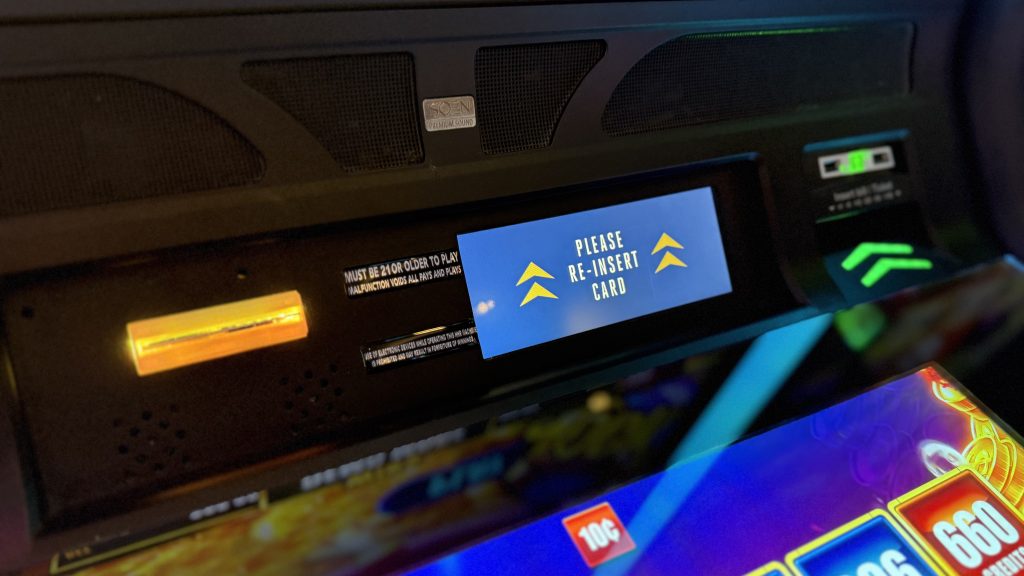
Players clubs give players a boost from a game’s return. The most common players club perk is slot points. These may usually be used for free slot play or comps. In some cases, cashback is available. Cashback does not require any wagering, while free slot play must be bet once before withdrawing it from the machine.
Other players club perks include comps to attract future action. This can be free slot play, table game chips, hotel rooms, and meals. Players club tiers also offer special perks like waived resort fees, free parking, invitations to special events, free drinks, and comped show tickets. Some VIPs even get travel expenses reimbursed or get comped access to shuttles.
Each of these forms of comps has a value that adds to a game’s return. In some cases, players can swing their payback over 100% when combining a game’s return with slot points and comps. It at least cuts into the theoretical loss.
How to Calculate Slot Points
Slot points are the most common players club perk. A point is awarded based on a formula related to the amount wagered. A common calculation is one point for every dollar bet on a machine and 1000 points equals $1 in free play or comps. That creates a slot point return of 0.1% as it takes $1000 in coin-in to earn $1.
Slot point formulas are not always that simple. Some pay $1 in slot points at 100, 300, 400, 500, 600, or 2000 points. It may take more than $1 in coin-in to receive a point. That makes comparing slot points between casino companies difficult. However, there is an easy way to calculate it as a percentage.
First, read the players club rules to determine how many points are required to earn $1. In this example, we will use 2000. Next, determine how many points must be earned for a slot point. Let’s use $1. That means a player must bet $2000 for $1 in slot points, for a return of 0.005%. That is twice as bad as the first example with $1000 per $1 in slot points.
On the other hand, a casino may give players $1 in slot points for every 500 points. In this example, assume it takes $2 to earn a slot point. That means $1000 in coin-in is required to earn $1. That is the same as a casino in the first example requiring 1000 points and awards one point for every dollar wagered. Note that some casinos award slot points at a slower rate to video poker players. It may take double up to four times the same coin-in to earn a point at video poker compared to slots.
Casinos often have slot multiplier days. These are typically during slow periods like graveyard shifts, weekdays, and when tourism is slow. This can increase your slot point return by at least double, up to 10 times, depending on the casino and offer.
Calculating Other Comps
While the percentage return of slot points is simple to determine, other comps that come from mailers and hosts are not. To find this value, one must first price what the comps would cost. For free slot play, take the amount and multiply it by the game’s hold. For slots, assume 90%. For video poker, use the paytable. It will usually be 97% to 99.5%.
If a casino offers $100 in free slot play, the theoretical value is about $90. A video poker player gets $97 up to $99.50. Food comps convert at the same value as paying cash. For hotel rooms, consider how much the same room would cost you. Make sure to include taxes and fees.
Let’s assume a casino offers a slot player three nights of free hotel worth a total of $500, $100 in free slot play, and $100 in food vouchers. Taking the house edge off the free play makes this offer worth $690.
If the slot player wagers $7000 on the trip, including the $100 free play, the trip theoretically costs $0. This is determined by dividing the free play amount by the house edge to find your breakeven coin-in. At $10,000 coin-in, the return drops to 97% as the player expects to lose $300 on the additional $3000 in coin-in. At $20,000, the player expects to lose $1300 more than the comps, for a return of 93.5%. All of this is before any slot points, so that return is added to the above totals.
Video poker players will see better returns, but may also receive offers with less value. Using the example above, a player on a 97% machine will theoretically stretch the $100 free play to $3333 in coin-in. The overall package’s value is $697. The player expects to break even at $23,233 in coin-in. At $50,000, the player still returns 98.4% before slot points.
Table Games Work Similarly
Table game players may receive free chips instead of slot play. Otherwise, those offers tend to be similar, though table game players must play longer and make larger bets to receive the same comps as slot players due to game speed. If a game holds 3%, it follows the same formula as the 3% video poker example above.
Don’t Play Just for Comps
Playing just for comps is a mistake. Casinos tend to only return 20% to 30% of the expected losses. If you only want the perks, pay cash for them. In the long run, it will be three to five times cheaper for most players who do not have an advantage play in mind. Players who give just enough action to cash in the free play are unlikely to receive future offers, as the casino may not see the value in inviting that guest again.
In the end, play within your bankroll. Enjoy the comps as a perk, not as a way to make money.













