

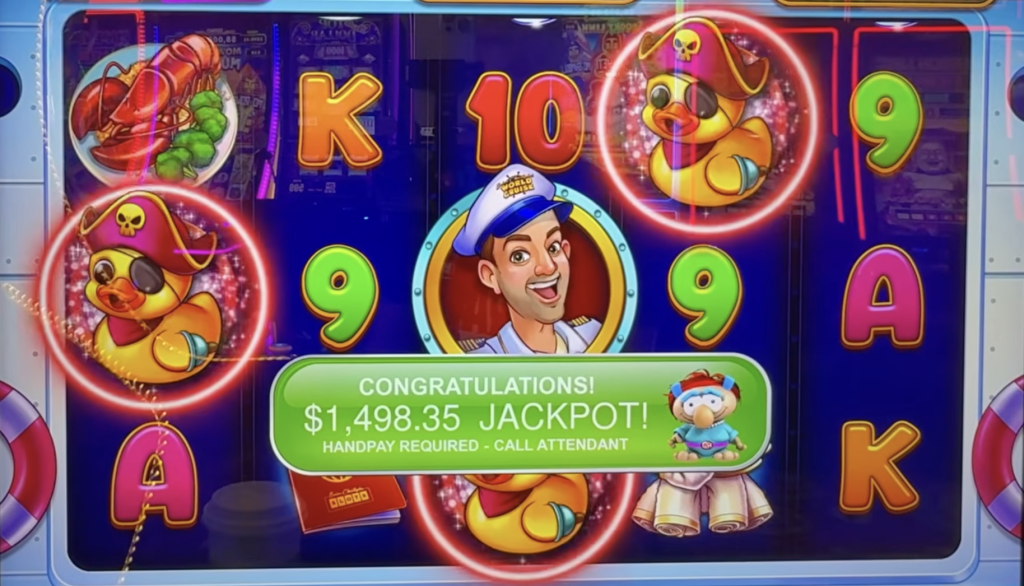
At the start of 2026, the jackpot handpay threshold increased to $2,000 (and will in the future increase with inflation). For a variety of reasons, some slot machines have not been updated to lock up at the new number, and for some players, that is a frustrating thing to discover. After a machine locked up in a recent BCSlots video at the old level, a viewer wanted to know why:
This is July already. So why are there still slots that haven’t been updated on the New jackpot handpay yet it’s been seven months since the new tax law on the New payout isn’t it against the law that they are not changing their machines over?
Joseph D.
Let’s go over some of the key reasons why machines might still lock up at a lower number.
The Slot Doesn’t Support a New Number
Some slots were simply not programmed to allow a change in the jackpot threshold. While many manufacturers have had this built in as a setting for some time, not all necessarily did, which means software updates would need to be developed, and deployed, where possible.
For older machines they may be old enough to not warrant a software update. Those will lock up at numbers below the current threshold for as long as they live on the casino floor.
This isn’t a new phenomenon; some of the Blazing 7 style machines would lock up below $1,200 when the top prize was awarded, and that was even in the $1,200 jackpot days. That problem won’t change with an even higher threshold.
State Taxes and Rules
Some states created laws around taxing gambling winnings that aligned with the threshold in place at the time nationally for IRS purposes. But state laws didn’t necessarily update just because the IRS rules did.
So in some states, machines still have to lock up at $1,200 to satisfy the state tax reporting requirements, or automatic collection in some states.
Casinos Haven’t Gotten To It
For a variety of reasons, some casinos held off implementing such a floorwide change. This may be because they wanted to wait for those aforementioned software updates so they can update everything at once. For others, it just wasn’t a big priority.
To your question about legality, a machine locking up at a number lower than the required is not against the law. That’s because there’s no paperwork requirements, so ultimately it’s a casino’s discretion to decide what to set them at, as long as they’re able to manage the reporting requirements once it reaches that IRS level.
Some locals casinos in Las Vegas, due to how they manage promotional events, will lock machines up even lower so they can offer the promotional prizes. Rest assured, if a machine locks up below the reportable level, it isn’t submitted by the casino, nor will you receive paperwork to file. It just means the cash retrieval/count in hand part is maintained (or in the cases of self pay, you can claim the money that way as well).
















It’s even worse at the NY State Racinos. They’re run by the lottery who has had a 600 reporting threshold for a long time. So if you slot win in say 650 it will lock up and you will have to show ID to get your money. Even worse is that it treats the ETG winnings the same way. Bet 350 on a hand of blackjack and win and out cones the ticket stating jackpot winner. Over 1200 and ID is required. This killed off most high rollers. Of course now that we have a real casino in Queens they follow the guidelines most places follow. No hand pay up til 2000. Win big at the tables and no paperwork either. Except……..there are radio chips in the gaming chips. It monitors you to see if you hit the magic 10,000 per day for a treasury report. Man at the blackjack table bought in for 5000 and lost it all. Bought in for more and wound up with a 3000 bet that needed a double down. Took out more cash and suddenly the game stopped. Suits showed up. Long discussion. Papers came out and the player had to fill out the cash report since he had bought in for 11,000 in a 24 hour period! If you bet big it’s reportable win or lose!
The New York Lottery structure of the racinos does create some interesting scenarios – when I lived about 45 minutes from Empire City I was mildly surprised to get a special ticket for winning just over $600 on a bonus one visit, and it then occurred to me that as non-slot slots as it were they followed lottery protocol for wins, which at the $600 threshold requires additional steps. I hadn’t thought about the aspect of Resorts World pivoting to traditional Vegas-style gaming while Empire City remains in the old format after they backed out of pursuing a gaming license. I do imagine having live tables and a broader selection of actual Vegas-style slots has an impact along with the jackpot rules.
The $10k reporting rule isn’t unique to Queens, of course, but they do seem to be more aggressive about tracking it based on how you’re describing it.
I know Genting had that big problem in Las Vegas and a huge fine because of that bookmaker. Wonder if they’re being extra careful now. Used to see guys betting with sacks of cash in AC with no questions asked. Fortunately I won’t ever have that issue as I don’t have nearly that much cash to play with. Just wonder if the high limit slots would track those large amounts of cash too? Thanks for the answer anyhow!
Slots is I think a bit harder to trace because of the cashing in/out regularly that many players will often do, that would mean the same money is being moved to different machines, etc, so the tallying of 10k into machines would be probably less helpful because it could end up being 1-2k that got moved around a lot. But it might also be market-specific given New York would operate under different regulations than Atlantic City. Those nuances between jurisdictions (as well as type of casino, as the racinos show) can have an impact on what reporting is required and when.