

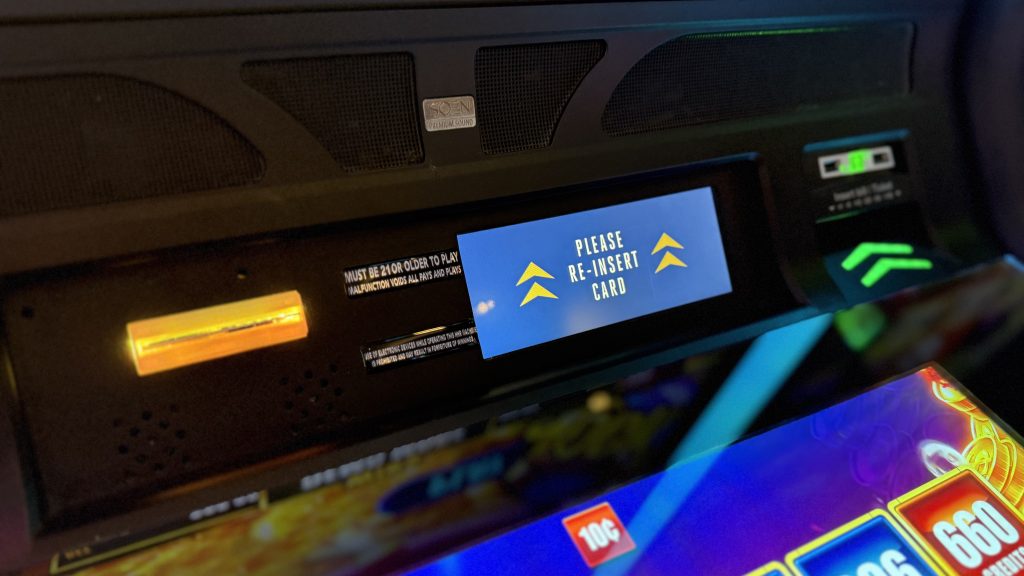
Sometimes having a bit of knowledge can skew a perspective on what’s happening. But, as always, the actual answer is much more boring and mundane. Such is the topic of our latest Casino Myth:
No question. Comment. Your article is 100% wrong. Do not play slot machines with your players card! I’ve worked for casinos and they absolutely do regulate your winnings. When anybody wins what they consider is “too much” for example….if you cash in let’s say a $400 ticket, then a $600, then a $300….you, your card is then flagged in the system as being “suspicious activity.” You won’t likely win again that day, not using your players card anyway. Should you continue to play, do not insert your players card. You might earn rewards with it, but it’s going to cost you. Just an FYI.
Kendra H.
We 100 percent believe casinos watch for suspicious activity by flagging players who are consistently winning (which, in the long term, is not expected because every game in the casino is mathematically designed with a house edge).
We just can’t follow you to the point where casinos are therefore manipulating those players’ payouts. That’s because, as we confirmed with IGT, one of the largest slot machine makers, such a feature doesn’t exist.
Let’s start with a few simple questions:
- Why would casinos offer a loophole where playing in one form would give players a chance to win more than another?
- Why would casinos create a scenario that could disincentivize players to give them valuable data? Wouldn’t that defeat the purpose of being able to track and flag players with suspicious activity to begin with?
- Why would regulators allow the casino to have any sort of player-specific control over payouts? That’s a system that could, and eventually would, get abused, which is why a random number generator operates within the slot, on its own, without outside influence.
Here’s what’s actually happening here. It’s true that casinos watch for sharp players. For instance, if a Blackjack player is counting cards, and is figured to be doing so through the ways they’re betting and other indicators of such a scenario going on, and winning over time against the casino, casinos will likely waive off their action at the Blackjack table, and say they can’t play that game at their casino anymore.
They won’t necessarily turn them away from a game like roulette or craps, where there isn’t a similar opportunity to find an advantage. But in some cases, players do get banned completely from a casino for these sorts of reasons.
Although somewhat rare, such a situation can occur on slot machines as well. Short term variance is normal – someone can be a winner in the short term. Casinos don’t sweat that players win in the short term, because with hundred or thousands of machines, this will even out. Our $400 or whatnot isn’t anything a casino would need to sweat when they’re making millions (or tens of millions, or even hundreds of millions) per year off casino players.
And even any single player may get lucky in the short term, but in the long term they will generally swing to a loss as well, unless something unusual like a Megabucks win occurs.
Where things change is when players are consistently winning, which means something else is more likely to be going on, aka “suspicious activity.”
Usually this can be determined by which slots they’re playing, because there is a subset of slots that offer true persistence – elements that evolve over time and do have value within the game. There are enough of these slots in some casinos, with enough frequency of scenarios that can be more positive for a player, that some can make money doing this. That’s what the systems are watching out for.
We are aware of players who have had their comps revoked by casinos for this. There are public threads about MGM Resorts doing this to some players, revoking their players club status and their offers, including comped rooms and free play, as a way to discourage these players from continuing to play at their casinos (but at the very least lowering their exposure to players who are already winning against them). We’ve also seen scenarios where casinos tell players that they’ve “won enough” and revoke their comps while they’re consistently ahead.
They don’t, however, change the slot paybacks on any player because of this, because they don’t have the ability to do so. But that “suspicious activity” flag is what they look at, and do the follow-up investigating to determine whether to implement those comp cuts or not. So that’s the benefit of it and why it exists.
Players who do take advantage of these scenarios where slots could be more likely to pay will use their players cards because the comps and points they get could make it a scenario where they come out ahead. But casinos have long pushed back here, even in more mundane scenarios like full pay video poker, by offering reduced or no comp points for play on those games.
So while we appreciate your reading, we can confirm the players card system can not manipulate slot payouts.













