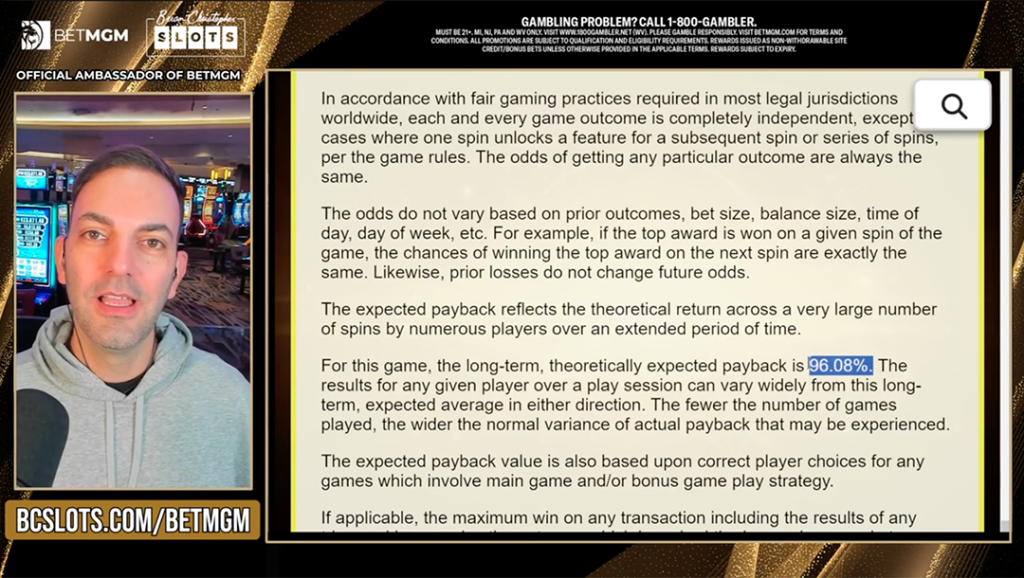
When a slot sits on the casino floor, it achieves its return to player, or RTP, over millions of spins from hundreds or thousands of players. Online slots load up for each individual player, so some think it works differently:
The odd thing about online “non-progressive” or “non-community jackpot” games is that 96% is per individual, whereas in real life that percentage would be paid over the lifetime of the machine and the dollars put in.
Brandon P.
This assertion is unfortunately incorrect. Otherwise, how would you explain a player who signs in and gets a lucky hit early and just walks? That slot could never achieve 96%. How about the player who loses on their first 10 spins and leaves? Same thing.
No, an online slot works the same as a physical one when it comes to RTP – it’s across millions of spins from hundreds or thousands of players, but instead of having a physical machine being played one at a time, it’s all software, and theoretically multiple people can by playing at once.
But it doesn’t change the foundation. The RTP is established based on the totality of possible outcomes that a slot can deliver, from losing spins to top jackpots. The random number generator is generating numbers that link to outcomes within that range, and each outcome has an equal chance of coming up at any given point. With the expectation of over time each outcome coming up roughly the same number of times as any other, that’s how it’s achieved.
Statistically, it doesn’t matter if it’s a series of players walking up to a single machine, or 100 people playing at the same time online – it still mathematically works towards the same goal, just with different wagering options.
So it’s very possible player A can hit a jackpot of $1,200 and be over 100 percent payback for their play, and player 2 lose their butts and be closer to 50 percent payback. That variability in slots still exists, and that RTP is across all players across the lifetime of a game.
Have a question? Submit yours here!