


There are topics that get players worked up. In my more than five years writing about slots, among the most feedback I’ve received to date came from our post on a study about cutting casino free play and how that relates to visitation.
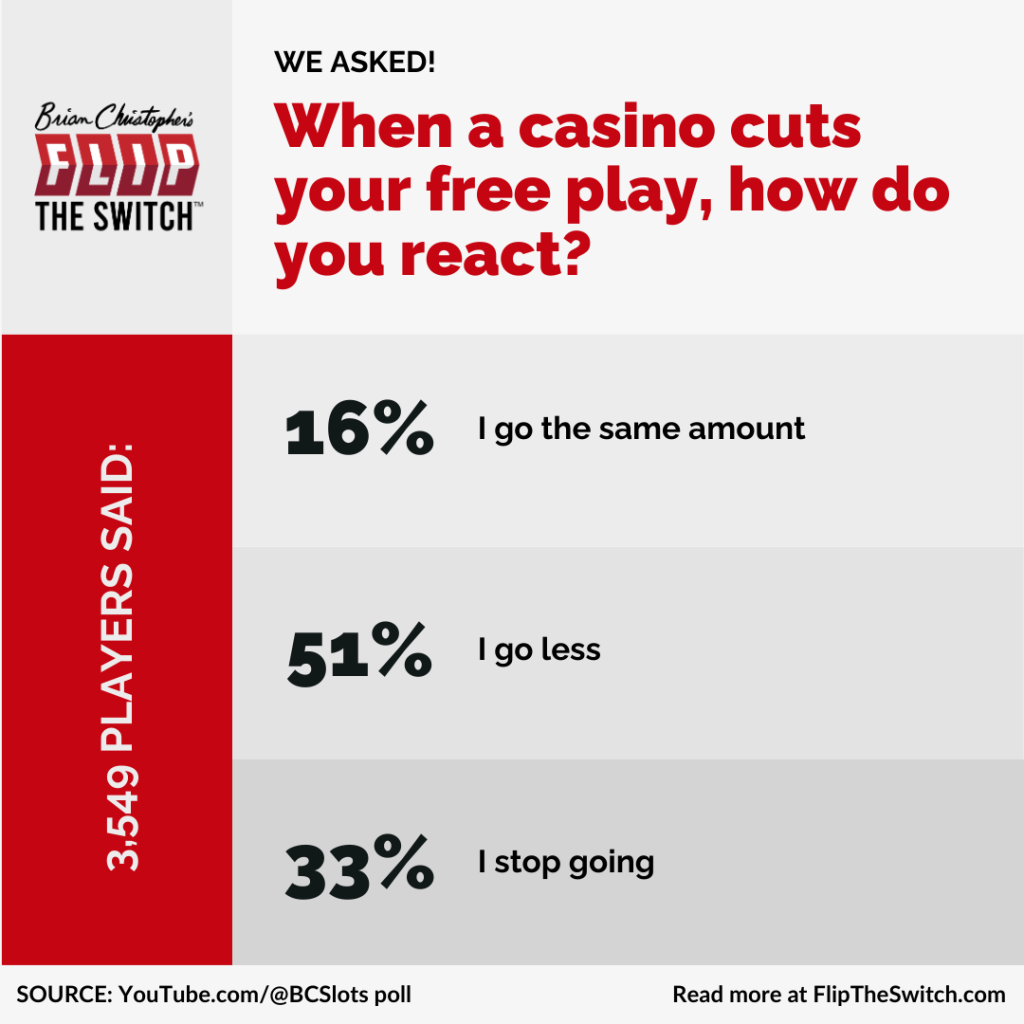
We also polled Brian Christopher’s YouTube channel audience, with more than half saying they either go less or not at all when their free play is cut, contradicting the study’s core findings.
We received quite a few comments from players, many attempting to refute, at least for them, what the study says. However, in reading through it, some throughlines come in that were more reflective of different scenarios, or perhaps even reinforcing what the study says, without their even realizing it.
Let’s explore a few categories that the comments came in, and then discuss why despite the reaction the study’s probably on to something.
Traveling is Expensive
Some players noted how their casinos were further away, and that things like rooms and food credits make a big difference. This makes sense, and we’ve even seen plenty of examples of offers differing based on a player’s location, in part to acknowledge that distance.
The study in question was looking at players getting a small amount of free play. This was a local’s casino offer scenario, where players go regularly because it’s nearby, where the offer isn’t a level that’s going to encourage players from a distance to travel to collect $15.
So it’s fair to say this study was looking more specifically at locals offers as opposed to ones encouraging players to move a certain distance.
Stop My Offers and I’m Out
A number of players said that they would stop visiting a casino if their offers were turned off. The study did note a reduction in visits from the player group that previously had offers and didn’t have them anymore.
But the visits didn’t stop altogether, and the likely cause for that, again, is that this looked at players closer to the casino. Some people go to the movies; others go to the casino, and if you’re in a rhythm of going weekly or whatnot, a difference of $15 may not be enough to disrupt those patterns.
Massive Cuts Aren’t Acceptable Either
Some players shared examples of $200 offers getting slashed to $50 – we see those examples and understand that scenario too. In the study, the starting point was $15 – and some were slashed to $10.
It’s a big differential to have a multi-hundred-dollar offer slashed by three-fourths (especially since offers of that size are often linked to a certain level of play), vs. $15 being trimmed to $10 – yes, a one-third drop, but also just a $5 drop.
Whoever is Most Generous Gets My Business
A third thread was around those who compare their offers and favors the casinos that are being most generous. This certainly would factor in if you have a number of casinos around you, but not everyone is in that position.
Where I’m based in California, the three closest casinos are all the same ownership, with a single unifying offer regardless of which one you’re visiting. Other casinos, which have been more generous, are farther away, so it’s a calculation – do I want to drive farther for the better offer? Here, the study calculus indicates that may not be so much of a concern.
So What’s Really Happening Here?
We’ve seen a similar situation around games getting tougher and more volatile. People complain about it, and we have players asking us why we don’t tell the manufacturers this and encourage them to rein it in. Well, the answer lies in the player behavior data casinos can see for themselves.
When reports come out from companies like Eilers and Krejcik about the top performing games, it’s consistently the volatile ones, the ones with the pots that don’t tell you anything, the ones that make you work for those super bonuses. We talk a good game, but we apparently play the ones we claim we dislike.
So why do players play them but say they don’t like them? Recent data shows casino traffic hasn’t rebounded to 2019 levels, but casinos are making record profits, so perhaps those who are currently voting with their wallet are putting their thumb on the scale, while those who aren’t impressed aren’t reducing spending enough to counteract the ones that are playing them.
But think about it – how many people are playing Big Hot Flaming Pots when all the money is in the bonus? People still like them because when you do get that bonus, it can be quite spicy (pardon the pun).
The same here goes for casino offers. When one Atlantic City casino was purchased, the first thing the new owner did (and it’s not an uncommon step that happens) was offers were slashed heavily. What was once one of the most generous casinos became one of the more stingy. Yet when we would go in there it’d still be a busy place, despite all the complaining about the changes in offers, and the reality is players are gonna play.
If you’re going to the casino with a small budget, a $15 bonus can be nice, but won’t really change the overall trajectory of a session. So if it’s reduced to $10, we may not like it, but will it really stop a visit? That’s probably the lesson of the study.













